NordVPN is the best VPN to avoid throttling from Thai ISPs like 3BB, bypass content blocks affecting news and media outlets, and speak anonymously on social media without risking jail time of up to 40 years. It also runs 16 servers in Bangkok, so your Thai banking apps and TV channels keep working while you’re connected.
After testing more than 21 VPNs for compatibility against censorship, online privacy, and throttling climate in Thailand, I rounded up a final four to sit behind NordVPN. Surfshark is my runner-up for its Bangkok server and unlimited devices, PrivateVPN gives you a static Bangkok IP on a small budget, and ExpressVPN and IPVanish complete the list.
In the rest of this guide, I discuss what makes each VPN suitable for Thailand, my testing and selection criteria, and how to properly set up your VPN for Thailand.
Let’s discuss.
Top 3 VPNs for Thailand (September, 2026)

Surfshark
Best for Thai households
- Bangkok server location
- Unlimited devices on one plan
- Camouflage Mode and NoBorders

NordVPN
Best for Thai local services
- 16 servers in Bangkok
- 8,400+ servers in 167+ countries
- Obfuscated servers for Thai ISPs

PrivateVPN
Best for a steady Thai IP
- Static IP on its Bangkok server
- Stealth VPN obfuscation
- Ten devices from $2.08 a month
It might look like Thailand operates a free internet. However, it’s regulated by the Royal Thai Police, the Communications Authority of Thailand, and the Ministry of Information and Communication Technology (MICT).
As early as 2021, Thailand passed the Computer Crime Act (CCA), which further clamps down on freedom of speech and expression. In fact, bloggers, expats, and travelers to Thailand can get arrested for anything deemed speaking against the royal government or promoting political dissidents.
Like most online censorships, the law is utterly open to interpretation.
Thus, the government and Thai police can manipulate it to ban websites, clamp down on citizens, and arrest erring ones.
Speaking of banning websites, Thailand restricted access to 34,000+ websites before the September 2006 coup. After the coup, the new military government ordered the blocking of 2400+ websites by request from the MICT.
As of this writing, it is estimated that more than 45,000 websites are blocked in Thailand.
On top of that, ISP throttling seriously threatens online freedom in Thailand.
Even if you paid for the most expensive plans on 3BB, TOT, CAT Telecom, or other internet service providers (ISPs), you’d only get a fraction of the promised speeds.
In most instances, the average difference between the promised speeds and what you get is a 50:1 ratio.
You shouldn’t have to suffer such slow internet speeds, fear of posting your thoughts online, and online privacy invasion on top of not getting access to the entire internet.
So, if you’re ready to break out of this internet cage, I’ll provide a quick overview of my top Thailand VPNs below.
These VPNs Help You Beat ISP Throttling and Avoid Royal Thai Police Surveillance

It’s time to defeat ISP throttling, circumvent Royal Thai Police’ online surveillance, and access thousands of blocked websites in Thailand.
Learn how my top VPNs can help:
- NordVPN – Get 8,400+ servers in 167+ countries to unblock banned websites, bypass harsh censorship, and improve your online privacy. Don’t forget the 16 Bangkok servers to unblock local content from outside the country or use the local web securely.
- Surfshark – Unblock content, get faster streaming speeds, and bypass censorship over 4,500+ servers in 100 countries. Plus, there’s a Bangkok server location to unblock local content and browse the local web securely on unlimited devices.
- PrivateVPN – Keep the same shared Thai IP address on its Bangkok server for banking apps, switch on Stealth VPN when a network blocks VPN traffic, and cover ten devices on one of the cheapest plans here.
- ExpressVPN – Enjoy ultra-fast obfuscation on all 3000+ servers, including a local Thai server, to unblock media streams in 4K! Additionally, ExpressVPN uses AES 256-bit encryption to prevent your ISP from getting access to your internet data.
- IPVanish – Employ On Demand VPN to automatically protect your Thailand internet experience whenever an active connection is detected. Also, enjoy 2000+ servers in 75+ global locations for fast streaming speeds and online privacy.
My top VPNs will unblock and stream content fast, obfuscate your traffic against VPN blocks, and provide reliable encryption against deanonymization.
However, they’re unique in how they offer these functions and are better than others in certain regions. So, continue reading to learn more about how these VPNs stand out.
Mini-Reviews and Comparisons of My Top VPNs for Thailand
After testing 20+ VPN providers, I streamlined the choice to these top five based on speed, security, reliability, encryption, and stealth, among other things.
Find out how these VPNs compare to make the best buying decision.
NordVPN – Best Value & Highly Reliable VPN for Thailand

NordVPN is my top pick for Thailand because it handles both sides of the problem: 16 servers in Bangkok (that’s the count on NordVPN’s own server list) for a local Thai IP, and 8,400+ servers in 167+ countries for everything the MICT and your ISP would rather you didn’t reach.
With the Bangkok servers, you get to:
- Unblock local Thailand online TV channels like BBTV Channel 7, Thai TV 3, and Amarin 34 HD from outside Thailand.
- Access Bangkok Bank, ICBC Thai, and other banking apps from outside Thailand.
- Secure your internet to use banking apps and continue streaming local content in Thailand without setting up split tunneling.
- Setup your VPN to see local content while bypassing content censorship.
On top of that, you get international servers to:
- Play online games like PUBG, Fortnite, and League of Legends from faster locations.
- Stream Netflix US, Amazon Prime Video, Hulu, and BBC iPlayer without lags.
- Unblock BBC, CNN, and other news content censored by the MICT.
- Get access to content in your home country if you’re traveling to Thailand.

Luckily, NordVPN maintains stellar speeds on these servers to help you unblock content in HD quality. That bypasses ISP throttling, too, so you instantly get better internet speeds than non-VPN users from Thailand.
ExpressVPN can edge it on raw speed, but that difference is hard to notice on a throttled 3BB or TOT line, and NordVPN asks less for its long-term plans.
Moving on, NordVPN provides AES 256-bit security on all servers and protocols.

This ensures your traffic is always tunneled by the secure VPN service, rendering it un-hackable to the Thai government or ISPs like KIRZ, TT&T, and CAT Telecom.
To be sure, I tested the encryption and didn’t get any IP/DNS leaks after connecting to NordVPN.

NordVPN backs that up with multiple protocols to facilitate speed and boost security.
It even includes an in-house NordLynx protocol built around WireGuard for reliably fast speeds, sturdy encryption, and robust security.
The only other in-house protocol on this list is ExpressVPN’s Lightway, which it built from scratch.
Besides that, you get the OpenVPN protocol (TCP) for obfuscation.

Thus, you bypass VPN traffic blocks and prevent your Thai ISP from knowing you’re using a VPN service provider. But you may have to contend with a more significant speed drop to use this feature, unlike ExpressVPN with its fast obfuscation speeds.
On top of that, you get dual kill switches from NordVPN to prevent IP and DNS leaks if the VPN connection drops. You can run both: the internet kill switch cuts everything, while the app kill switch closes only the apps you pick, such as a browser logged in to your social media accounts.

Without this kill switch, you risk getting deanonymized if the VPN loses connection to a remote server even for a second.
Thankfully, NordVPN is an audited no-logs provider, making it extra secure against server hacking. Even if the Royal Thai Police or MICT could get their hands on any NordVPN server, they won’t find any user data.
Additionally, NordVPN is out of Thailand’s jurisdiction by setting up shop in Panama. So, collecting your data and handing it over to the Thai police can’t legally be required.
There’s also Threat Protection, which blocks malicious domains and trackers. The Pro version on the Plus plan and up also scans downloads, which helps when the mirror sites that appear after a MICT block are the only way to reach a page.
For all that, NordVPN allows you to use a single subscription on ten simultaneous devices, and every plan comes with a 30-day money-back guarantee.
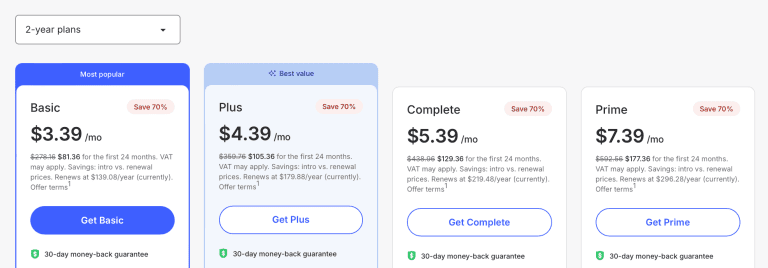
Speaking of, get even better value with these NordVPN discounts.
Pros
- 16 servers in Bangkok for a local Thai IP
- 8,400+ servers in 167+ countries
- AES 256-bit encryption
- Dual kill switch for IP/DNS leak protection
- In-house NordLynx protocol for speed and security
- Audited no-logs policy in Panama, outside Thai jurisdiction
Cons
- Obfuscation is slow
- Ten devices, while Surfshark sets no limit
Surfshark – Cheap Thailand VPN With Unlimited Device Connections

My runner-up, Surfshark, allows you to stream geo-restricted content, unblock local services, defeat KIRZ or 3BB throttling, and still hide your online activity from MICT across unlimited devices under a single subscription.
On top of that, Surfshark doesn’t compromise on security to make that happen and won’t throttle your connection bandwidth to make this unlimited connection happen, either.
But that’s not the best thing about this provider.

Its 4,500+ servers in 100 countries outnumber ExpressVPN’s 3,000+, and only NordVPN reaches more countries on this list. While it might not be as fast as those two providers, Surfshark’s least fast servers are optimized for up to 1Gbps.
So, it’s fast enough to unblock and stream content in HD.
One of those locations is Bangkok (it’s on Surfshark’s current server list, with P2P allowed), so you can access local banking apps, stream Thai TV channels, and surf the local web without setting up split tunneling.
Also, this local server makes life easier for Thai residents and citizens traveling abroad while keeping in touch with local content.
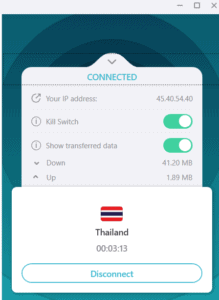
On top of that, Surfshark provides the standard VPN protocols for speed, security, obfuscation, and privacy.
However, it doesn’t engineer an in-house protocol like NordVPN or ExpressVPN, choosing the stock WireGuard instead.
Also, Surfshark mimics NordVPN by using OpenVPN protocols for obfuscation.

Dubbed Camouflage Mode, this protocol also causes a noticeable speed drop that makes it undesirable compared to ExpressVPN’s ultra-fast obfuscation speeds.
However, it employs AES 256-bit protection on all servers and protocols. Thus, you can rest assured that the Royal Thai Police, MICT, or any other government spy bodies don’t know what you’re doing online.
I didn’t take Surfshark’s word for it, so I tested for IP and DNS leaks when connected to some of its servers. Luckily, it didn’t fail any of my tests.

On top of that, Surfshark provides a kill switch to prevent IP/DNS leaks on VPN random disconnections.
The iOS app has the toggle too, so make sure it’s on before you join Wi-Fi at a Bangkok café or a Phuket hotel.
Furthermore, Surfshark impresses with additions of the NoBorders Mode and Rotating IPs, which come in handy for Thai residents.
The NoBorders Mode automatically triggers once it senses online censorship, recommending desired servers to unblock the content.

On the other hand, Rotating IPs improve your privacy and anonymity by randomly changing your IP address while remaining connected to a preferred server location.

So far, Surfshark is the only VPN provider to offer any or both of these features.
Two more extras earn it second place here. Bypasser, Surfshark’s split tunneling, lets a Thai banking app use your normal connection while your browser stays behind the VPN, and CleanWeb strips ads, trackers, and malware domains, a real help on the gambling and streaming mirror sites many Thais end up using.
Perhaps the only concern I have with Surfshark is that it’s based in the Netherlands, a 14 Eyes surveillance country.
However, it’s an audited no-logs provider, and the Netherlands isn’t in any data-sharing alliance with the Thailand government. Still, that Dutch base is why NordVPN, sitting in Panama with a second kill switch and Double VPN on top, stays ahead of it for Thai users worried about surveillance.
Surprisingly, Surfshark is one of the most affordable VPN providers, even though it allows unlimited simultaneous connections.
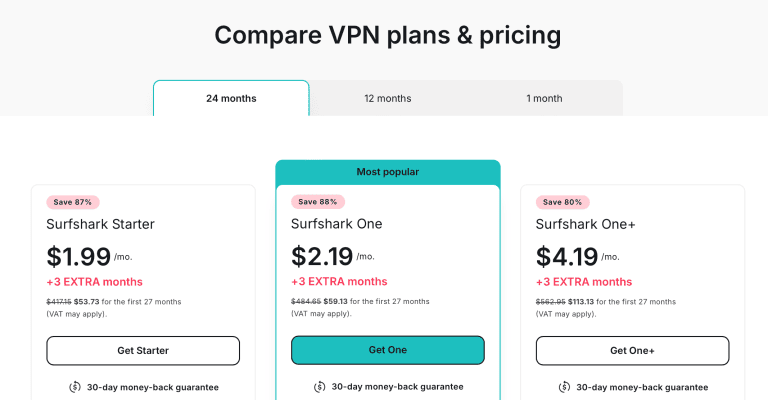
Even so, use these Surfshark discounts to get even better value on your purchase.
Pros
- Bangkok server and a local Thai IP
- 4,500+ servers in 100 countries
- AES 256-bit encryption to prevent leaks
- Kill switch on every app, iOS included
- Rotating IPs, NoBorders Mode, Bypasser, and CleanWeb
- Audited no logs provider
Cons
- No in-house protocol like NordVPN and ExpressVPN
- Based in the Netherlands, a 14 Eyes country
PrivateVPN – Static Bangkok IP and Stealth VPN on a Budget

PrivateVPN is the smallest provider on this list, with 200+ servers in 63 countries, but it has the one location Thai users care about most: a server in Bangkok, listed on PrivateVPN’s public server page with WireGuard support.
What sets that Bangkok server apart is the address it gives you. Every PrivateVPN location uses a shared static IP, so you get the same Thai IP each time you reconnect. Bangkok Bank, SCB, and KBank apps tend to ask fewer security questions when your login address doesn’t change from one day to the next, and that holds just as well for a Thai abroad checking an account from a hotel in Tokyo or London.
Inside Thailand, the feature I’d switch on first is Stealth VPN. It disguises the tunnel as ordinary web traffic, which is what you want on a network that throttles or blocks recognisable VPN connections. Like NordVPN’s obfuscated servers and Surfshark’s Camouflage Mode, it runs over OpenVPN, so expect slower speeds while it’s on.
The rest of the time, WireGuard is the protocol to pick, with OpenVPN, IKEv2, L2TP, and PPTP also available. A full-system kill switch on Windows, macOS, iOS, Android, and Linux blocks your connection if the tunnel drops, so an anonymous post never goes out from your real IP address.
Expats and travelers get the other 62 countries for home-country services, and on selected locations PrivateVPN also runs dynamic dedicated IPs over OpenVPN for sites that refuse a shared address. There’s no split tunneling, but with a Bangkok IP you rarely need it to reach local sites.
It ranks third for one reason that matters in Thailand: nobody outside the company has audited its zero-logs claim, and it’s based in Sweden, a 14 Eyes member. When the Royal Thai Police are the ones you’re hiding from, NordVPN’s and Surfshark’s independently audited policies count for more.
The price is what wins people over: ten simultaneous connections for $2.08 a month on the 36-month plan (billed at $75 a year after that), with a 30-day money-back guarantee.

Grab these PrivateVPN discounts to keep a Bangkok IP for less.
Pros
- Bangkok server with a shared static Thai IP
- Stealth VPN obfuscation for networks that block VPNs
- WireGuard, OpenVPN, IKEv2, L2TP, and PPTP
- Full-system kill switch on desktop and mobile
- Ten devices for $2.08 a month on the 36-month plan
Cons
- Zero-logs claim not independently audited
- Based in Sweden, a 14 Eyes country
- No split tunneling or ad blocker
ExpressVPN – Fast Obfuscation to Bypass VPN Traffic Blocks in Thailand

ExpressVPN has the best obfuscation on this list, and it would rank higher if price didn’t matter. For most Thai users it does: ExpressVPN costs more than NordVPN, Surfshark, or PrivateVPN, and you’d be paying that premium on top of a 3BB or AIS bill that already doesn’t deliver the speed you signed up for.
Its 3000+ servers are also fewer than NordVPN’s or Surfshark’s, but ExpressVPN covers 113 countries, so your preferred country is very likely on the list.

Fortunately, ExpressVPN provides a local Thailand server location to unblock local content and secure your local internet experience.

On top of that, ExpressVPN enables obfuscation by default on all servers and protocols. It’s the only provider on this list to offer that, and it gets even better:
ExpressVPN’s obfuscation speeds are unmatched, making it the best Thailand VPN to bypass VPN traffic blocks without taking a serious connection speed hit.

What’s more, ExpressVPN designed the Lightway protocol from the ground up to support ultra-fast speeds, tunnel your internet data securely, and give you top-notch privacy.
Using Lightway, you can:
- Stream Netflix US (or other regions), Hulu, Amazon Prime Video, and BBC iPlayer in 4K from Thailand.
- Get lower ping and enjoy faster, no-lag gameplay across Apex Legends, League of Legends, Clash of Clans, Mobile Legends, and other titles.
- Defeat VPN traffic blocks to censored content set up by your ISP without suffering network drops.
Moreover, ExpressVPN uses the same AES 256-bit encryption as NordVPN to keep MICT and your Thai ISP out of your internet data.
So, they can neither see what you’re doing online, intercept your shared files, nor see the content of your conversations.
As I did with NordVPN, I also tested the ExpressVPN encryption, and I wasn’t disappointed.

Even so, there’s a Network Lock kill switch technology to prevent IP/DNS leaks if the VPN connection drops randomly.
Fortunately, the Thai government can’t compel ExpressVPN to hand over any user data since it’s based in the British Virgin Islands, outside Thai territory. And ExpressVPN was audited twice for its no-logs claims, so no user data will ever be found on its servers.
In fact, there was a Turkey incident where Turkish authorities seized ExpressVPN’s local servers and found zero data.

Moreover, ExpressVPN isn’t only great for its obfuscation speed.
Even compared to other VPNs using WireGuard, ExpressVPN still manages to take the fight to them and beat them most times.
Thus, it’s a great tool to unlock the promised bandwidth speeds on 3BB, CAT, KIRZ, or your preferred Thai ISP.
However, ExpressVPN is one of the most expensive VPNs I reviewed. Thankfully, its Basic plan now covers ten simultaneous device connections for a better value.

Also, you can enjoy these ExpressVPN discounts to save more on your purchase.
Pros
- Local Thailand servers
- 3000+ servers in 113 countries
- Reliable AES 256-bit encryption
- Network Lock kill switch against IP/DNS leaks
- In-house Lightway protocol for fastest obfuscation speeds
- Twice audited for no-logs claim
Cons
- Expensive VPN provider
- Not as many servers as NordVPN
IPVanish – 2000+ VPN Servers to Unblock Content in Thailand

IPVanish provides 2000+ high-speed servers in 75+ locations to stream Netflix, Hulu, BBC iPlayer, and other media content fast from Thailand.
Its content unblocking is also reliable enough to access banned pornography sites, gambling websites, and news channels.
However, there’s an apparent lack of Thai servers.
So, Thai residents need to set up split tunneling to use the VPN in Thailand and still have access to:
- Local websites and stores
- Local web search results
- Local TV channels like BBTV Channel 7, Thai TV 3, and Nation TV
- Banking apps
The issue is that IPVanish doesn’t offer split tunneling on PC and iOS. Considering this is a standard PC app feature on NordVPN, Surfshark, and ExpressVPN, it’s surprising that it’s missing here.
So, IPVanish is excellent for unblocking content available in other countries, ensuring online privacy, and improving anonymity from Thailand.
But you might lose local content access once connected.

Regarding security and privacy, IPVanish provides standard, reliable protocols with AES 256-bit encryption.
It also offers obfuscation under the OpenVPN protocols, but you have to enable a different Scramble setting to use it.
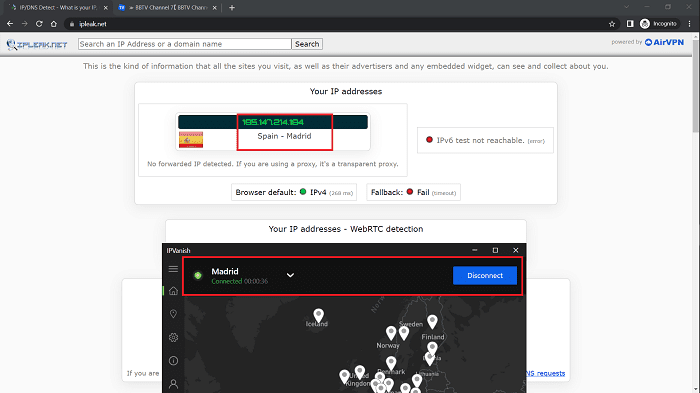
Unfortunately, you don’t get the OpenVPN protocols from IPVanish on iOS.
So, you can’t enjoy obfuscation, leaving you vulnerable to harsh censorship and VPN traffic blocks by your ISPs or the Thai government.
It makes up for that by offering an automatic connection on untrusted Wi-Fi networks.
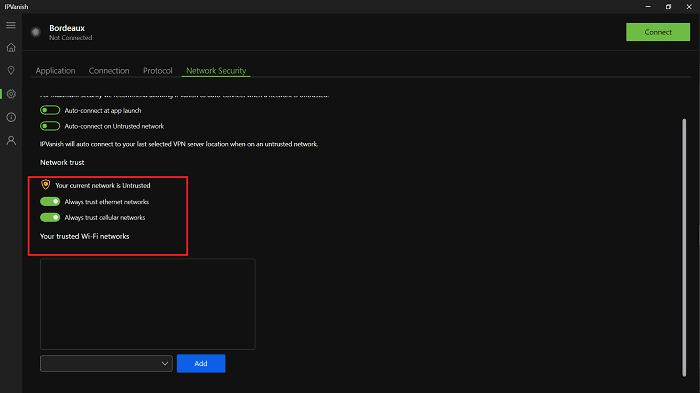
This will come in handy when connecting to free Wi-Fi networks at the Phuket International Airport, Little Moon café in Bangkok, Sugar Hut Resort in Pattaya, or anywhere else.
NordVPN and Surfshark also offer something similar, but it’s noticeably missing on ExpressVPN.
Such automatic connections give you an extra layer of security since public Wi-Fi networks are notorious for
- Data packet sniffing, where the network admin can see everything you’re doing on the network.
- Invasive data collection, where the free Wi-Fi provider collects personally identifying data and can sell it to third-party buyers.
- Session hijacking, which can give a hacker backdoor access to your device, your apps, and files.
- Man-in-the-middle attacks, where your conversations and files you send are intercepted before reaching their intended destination/recipient.
- Malware injection once a hacker has access to your live web traffic.
- Live traffic decryption to discover sensitive details like your online banking logins, account passwords, etc.
Like Surfshark, though, IPVanish is also based in a 14 Eyes country (the United States).
Also, IPVanish was audited for its no-logs claims. However, there are some discrepancies in that audit report that could make you call the entire thing into question.

Still, there haven’t been any recent data logging issues on IPVanish, so it deserves the benefit of the doubt. Likewise, I doubt the Thai government can impose on the US to request that IPVanish collects and hands over user data.
Again, like Surfshark, IPVanish also allows unlimited simultaneous connections with unlimited bandwidth across as many mobile and PC devices as you have.

Despite that, grab these IPVanish discount deals while they last for better value on your purchase.
Pros
- 2000+ servers in 75+ locations
- AES 256-bit encryption
- Kill switch to prevent IP/DNS leaks
- Audited no-logs VPN
Cons
- No local Thai servers
- Doesn’t offer split tunneling either
- No obfuscation on iOS
- Based in the USA
The State of the Internet, Online Censorship, and Tracking in Thailand
Thailand often isn’t on the radar for online censorship and content blocks because it’s not as invasive as China, Vietnam, and other more serious enemies of the internet.
However, the country’s officials have blocked access to tens of thousands of websites in the past two decades alone.

The MICT and Royal Thai Police also continually identify websites to block, citing loose definitions of falling within a broader banned category to justify these blocks.
Learn more about these website blocks, personal privacy breaches, and censorship that make you need a Virtual Private Network (VPN) in Thailand.
Internet Censorships and Enforcement
Internet censorship in Thailand is formally defined by the supporting legal documents to only affect sites based on:
- Pornography
- Sex equipment and related items
- Abortion
- Threats to national security
- Criticisms of the government or military
- Illegal products
- Illegal services
- Copyright infringement
- Online gambling
However, this has only given the government and its agencies sweeping powers to censor any kind of content they want.

Whether on blogs, social media, or other online platforms, the Royal Thai Police and MICT are working overtime to stifle freedom of speech and expression.
Likewise, this arrangement has given them room to block a lot more websites than initially defined.
Looking at the timeline of these blocks, some of the most notable numbers are
- 110,000 websites blocked between the September 2006 coup and 2010.
- 22,500+ websites blocked by the Cyber Security Operation Center between December 2011 and March 2014.
- 2475 websites blocked in October 2006 alone.
There’s more, but that gives you an idea of the level of censorship we’re dealing with here. Sadly, a lot more blockages go unreported. So, these numbers may merely be the tip of the iceberg.
Online Tracking and Arrests
CAT Telecom and TOT are two of Thailand’s biggest telcos and ISPs.
Sadly, they’re also largely state-owned, putting them at the Thai government’s beck and call.
Thus, it’s easier for the government to enforce censorship by banning websites at the ISP level for the majority of users in Thailand.
Also, the government can reach into the user-collected data at these ISPs to find:
- Your IP addresses
- Your registration details (which include your name and physical address)
- Your internet activity (which shows everything you’ve done online)
With that information, the Thai police can monitor your online activity, collect data about every online interaction, and build a shabby enough case to arrest you.
This isn’t all gossip, given the number of expats, travelers, bloggers, and other online users picked up for flimsy crimes.
But what about the ISPs that aren’t state-owned? History has shown that the Thai authorities also have their hands in that pie.
For example, the MICT “requested” that private-run ISPs block access to some websites. Subsequently, the body also stated that ISPs who don’t comply could have their operating licenses taken from them.

So, if the MICT can wield that influence to get these ISPs to block websites, it’s not far-fetched to think it’ll also have access to user data.
Furthermore, leaked emails in 2015 revealed that the Royal Thai Army and Royal Thai Police ran up a tab reaching half a billion dollars in the acquisition of online surveillance tech.
Dubbed Remote Control System, this piece of tech is supposed to evade detection, invade user privacy to monitor communications, and collect sensitive data.
It’s almost a decade down the line from then, and it’s only a wonder what new tech the government now has to infiltrate your devices.
Rampage of ISP Throttling
As if the government isn’t making online life hard enough, Thai ISPs are notorious for offering users less than the advertised bandwidth. Some users reported a difference on a 1:50 scale, considering the speeds they got to what they’re paying for.
This is common among top providers like 3BB, CAT, TOT, and KIRZ, so it’s not only the emerging players responsible for this issue.

However, there seems to be common ground: these ISPs throttle international traffic requests more than local ones. Looking at that, it’s sure they can see what you do on the internet.
So, it’s little wonder these ISPs will throttle you when streaming media content, downloading large files, or sending large amounts of data at once.
Since you’re paying for that service, you should get the bandwidth allocation you deserve. No matter what you’re doing.
I’m also convinced that these ISPs know what they’re doing but don’t care since there’s no one to hold them accountable.

After all, there are claims that ISPs like 3BB don’t throttle their speeds to specific bandwidth testing apps, so users think they’re getting the full blast.
Once you try on an existing website/online platform, the problem is back.
What Websites Are Blocked in Thailand?
Thailand blocks access to social media websites like Facebook, restricts access to some critical pages on BBC, and prevents users from placing bets online.
After seeing the tens of thousands of website-blocking requests that the MICT sends to ISPs, it’s impossible to pinpoint the geo-restricted websites in Thailand.

However, we can approximate some based on the popular website blocks still existing in the country, including:
- Social media websites like Facebook
- Anti-coup websites
- Specific web pages on notable news websites like BBC One, BBC Two, CNN, Yahoo! News
- Online discussion boards like the Midnight University
- Certain Wikipedia pages
- Internet Wayback Machine to prevent Thais from accessing original, unmodified content
In light of that, some websites were blocked and unblocked by the MICT but still stand the risk of getting blocked. Among these are:
- YouTube
- Camfrog
- Wikileaks
These, alongside the ISP throttling and harsh censorship, show why you need a VPN to enjoy the free internet in Thailand. That’s why I put thought into my top Virtual Private Networks (VPNs), ensuring they tackle these problems.
If you’re also ready to break free, continue reading to learn how I chose my best VPN services for Thailand.
How I Chose the Best VPNs for Thailand? (Selection Criteria + Tests)
I started with 20+ VPNs and tested them based on speed, security, reliable encryption, privacy, and special extras that make them suitable for Thailand.
I also ensured the VPNs were appropriate for Thai citizens and residents traveling outside the country.
So, let’s discuss the testing and selection criteria that slim-fitted my initial list to the final top five.
Speed
I chose VPNs that are specially optimized for speed to:
- Bypass ISP throttling in Thailand
- Reduce the connection drop that a VPN’s encryption introduces
- Unblock content streams fast without lags
Thus, my recommended VPNs are fast enough to get you better domestic and international speeds than you get from 3BB, TOT, CAT, or other ISPs without a VPN.
Servers
I looked for VPNs that provide a global server network spanning thousands of servers in multiple countries to ensure:
- Thai travelers, expats, students, and tourists can unblock content available in their country from Thailand.
- Access multiple streaming channels from anywhere.
- Less server overcrowding to ensure the fastest speeds and performance on every server.
- A ton of connection options, no matter what servers you prefer.

Likewise, I chose VPNs with Thai servers to allow residents to:
- Stream local content while staying secure.
- Browse the local Thai web anonymously.
- Speak freely on anonymous local social media accounts without risking arrest.
- Watch Thai TV 3, BBTV Channel 7, and other local Thai TV channels.
Also, Thai residents and citizens traveling to other countries need these local servers to:
- Keep in touch with local content.
- Unblock Bangkok Bank, Tisco Bank, ICBC Thai, or other Thailand bank apps.
- Connect to local Thai game servers.
Fortunately, the VPNs on my list (except IPVanish) offer Thai servers and IP addresses.
Security
Your choice VPN should have a reliable kill switch and use AES 256-bit encryption on all servers and protocols. That way, you can protect yourself against the MICT and Royal Thai Police surveillance.
Some of my top VPNs (like NordVPN) even provide two kill switches!
Privacy
Never choose a VPN located in a country that shares data with Thailand or has draconian anti-privacy laws, which could make it obtain your data from the provider.

On top of that, ensure your chosen VPN provider is a no-logs provider.
Bonus points if it was audited for these claims by a reliable, independent third-party firm.
Looking at my top providers, NordVPN, Surfshark, ExpressVPN, and IPVanish have all had their no-logs claims checked by outside auditors. PrivateVPN is the only one yet to undergo an independent audit, which is a big part of why it sits third rather than higher.
Multiple Protocols
You need multiple VPN protocols to surf the web privately, bypass VPN traffic blocks, and get faster speeds against your ISPs or the Thai government.
Some of the protocols provided by my top VPNs and what they do are:
- WireGuard: best for speed without sacrificing security.
- NordLynx: optimized for speed and exclusive to NordVPN.
- Lightway: Overall best for speed and security, and exclusive to ExpressVPN.
- OpenVPN: Often used for obfuscating VPN traffic and bypassing strict censorship.
- IKEv2: Great for mobile devices and makes reconnecting a breeze.
There are other protocols like L2TP, PTPP, and IPSec too. However, the above are the most important on any VPN you choose for Thailand.
Which VPNs Should You Avoid in Thailand?
Avoid free VPNs, VPN providers with recurrent past scandals, unaudited providers in surveillance regions, or VPNs within Thai jurisdiction.
Here’s a complete overview of VPNs to avoid in Thailand and why.
- Free VPNs. Most free VPNs don’t encrypt your internet data securely.
- VPN providers with unfixed scandals. Otherwise, you risk falling victim to the same scandal that rocked the VPN in the past.
- VPNs within Thai jurisdiction. This means they can be compelled by the MICT or Royal Thai Police to give up your connection logs or collect data on you.
- VPNs that collect logs. Logs can be hacked, sold to the Thai government, or mismanaged such that they’re exposed.
- Unknown VPNs. The Thai government can set up some shady VPNs to collect your data while it tricks you into thinking you’re protected online.
Can You Use a Free VPN in Thailand?
You shouldn’t use a free VPN in Thailand since it won’t encrypt your internet traffic securely.
Thus, leaving your actual IP address, connection logs, and other personally identifying information exposed to your ISP, who can hand that data over to MICT and the Royal Thai Police.
Likewise, free VPNs are often slow and will limit your bandwidth on top of the already throttled bandwidth from your ISP. Also, free VPN providers are notorious for collecting logs to sell for a profit, further invading your privacy rather than protecting it.
Thus, I recommend a good value VPN like NordVPN for Thailand.
If you’re considering the price, split the cost of a Surfshark VPN among multiple users since you can simultaneously use the software on unlimited devices.
How to Setup a VPN in Thailand?
Enable the internet kill switch before/after connecting to any VPN secure server, choose the suitable protocol for connection and select a preferred server to layer your internet connection over.
Here’s how to choose a preferred server location
- Choose the desired VPN. I recommend NordVPN for PC and mobile users.
- Click the “Quick Connect” button to get the fastest server in the fastest location.

- OR search for a preferred server location. I’ll choose Norway for this example.

- Double click the preferred location.

- Wait for the connection confirmation.

- Surf the web from your chosen location.
How to Get Thailand IP Address With a VPN?
Thailand residents can get a Thailand IP address to browse the local web securely, retain access to local content (like banking apps and online TV channels), and stay secure against MICT’s online privacy invasion.
Likewise, Thai citizens and dwellers abroad can get a Thai IP address to unblock media content, apps, and programs like home.
Here’s how to get a Thai IP address.
- Choose a VPN with a Thailand server location. I recommend NordVPN.
- Search for Thailand.

- Double click on the server location.

- Wait for the connection confirmation.

- Surf the web like you’re in Thailand.
You can perform a leak test from ipleak.net to be sure your internet connection is now layered over the VPN, especially if you’re initially browsing from Thailand.

That way, you never mistakenly assume you’re still getting local content on the Thai servers when, in fact, the VPN isn’t active yet.
Can You Blog Anonymously With a VPN in Thailand?
You can operate an anonymous blog with a VPN in Thailand by connecting to a reliable VPN server before logging into your blog to post content, moderate comments, or perform other admin duties.
However, a VPN alone can’t protect your privacy, as you also have to be careful against revealing personally identifying information, such as your:
- Real name
- Address
- Phone number
- Employer
- School
Likewise, always enable the VPN kill switch to prevent the Royal Thai Police from finding out who you are when the VPN randomly disconnects.
What to Do When Your VPN Isn’t Working in Thailand? (Troubleshooting Guide)
Troubleshoot your VPN not working in Thailand by following the pointers below, in no particular order:
- Choose a reliable VPN provider. You’ll find that most of your VPN not connecting issues can be solved by choosing a reliable provider like NordVPN.
- Check your credentials. Your login credentials on a router VPN software often differ from the main VPN login. So, check to ensure you’ve got it right.
- Switch VPN servers. Change your server, as the one you’re on may be overloaded, down for maintenance, or not suitable to unblock the kind of content you’re targeting.
- Change your VPN protocol. You may need to change VPN protocol to get more speed (WireGuard/Lightway/NordLynx), obfuscate your VPN traffic (OpenVPN/Lightway), or other specific purposes.
- Check open or blocked ports. Some VPNs allow port forwarding, so check that you’ve not opened or blocked any crucial ports. Likewise, some providers offer ports you must keep open to tunnel through them.
- Update the VPN app. Because a simple update may sometimes fix bugs otherwise causing the VPN software to not work.
- Reinstall your VPN driver/configuration. A faulty VPN driver or corrupted configuration may cause it to misbehave. Luckily, most VPN providers offer a one-click solution to this in their apps.
- Reinstall the VPN app. You may need to uninstall and reinstall the VPN app, especially on PCs. However, it’s doubtful you need this solution with the robust infrastructure on NordVPN.
- Check your VPN connection. A good VPN will shut down your internet connection if it loses connection to a remote server while you have the kill switch enabled. So, check that you’re still connected to a remote server.
- Check your device firewall. Sometimes, your device’s firewall may be blocking VPN access. In this case, whitelist the VPN with the firewall.
- Contact customer support. If all else fails, contact customer support, and they’ll be glad to help. Fortunately, my top VPNs provide 24/7 customer support.
Frequently Asked Questions
Can I Use ExpressVPN in Thailand?
You can use ExpressVPN to bypass censorship in Thailand, thanks to its obfuscation on all servers and protocols. ExpressVPN is also ultra-fast, especially over its Lightway protocols, allowing Thai users access to online streaming services in 4K.
Likewise, ExpressVPN employs industry-standard AES 256-bit encryption to protect user data from MICT and Thai ISP data collection for the highest privacy.
Fortunately, ExpressVPN has easy-to-use mobile and PC apps for stellar multi-platform support and total protection.
Can I Watch Porn in Thailand With a VPN?
You can unblock and watch porn in HD in Thailand by connecting to VPN server locations (such as Nigeria, Singapore, Canada, and the US) where popular porn websites are available.
Additionally, VPNs like NordVPN and ExpressVPN use best-in-class encryption to prevent 3BB, KIRZ, CAT, and other Thai ISPs from seeing you’re watching porn online. Thus, they can’t collect this data to share with the Royal Thai police or throttle your bandwidth to induce buffering.
Is a Proxy Faster Than a VPN in Thailand?
A proxy is faster than a VPN since it lacks encryption.
So, the proxy address still reveals your IP address, geolocation, and internet activity to MICT, your ISPs, and the Thai police. Also, proxies are unreliable at unblocking content and bypassing harsh censorship.
Thus, I recommend fast VPNs like NordVPN and Surfshark to bypass ISP throttling for better speeds, unblock content streams up to 4K quality, and still encrypt your data from the Thai government.
What’s the Best VPN for Cabal Mobile in Thailand?
NordVPN is the best VPN for Cabal Mobile in Thailand.
It has Vietnam, South Korea, and Thailand server locations, all of which are locations where Cabal M is available. NordVPN’s fast servers also help you get a lower ping and bypass ISP throttling for smoother gaming speeds.
Furthermore, NordVPN offers DDoS protection on all servers across all protocols, protecting you against grumpy gamers and cheats who resort to shady DDoS attacks to win.
What’s the Best VPN for Thailand on Android?
NordVPN’s easily navigable and feature-packed Android app makes it the best bet for Samsung, OnePlus, Xiaomi, Vivo, and other Android devices in Thailand.
NordVPN offers 8,400+ servers in 167+ countries, including 16 servers in Bangkok to keep streaming local content, and reliable encryption to keep your Android internet activity secure from the Thai government.
Also, you get public Wi-Fi protection to secure your device and data from malware attacks, session hijacking, and other public Wi-Fi dangers.
Does Surfshark Work in Thailand?
Surfshark works in Thailand across PC and mobile devices.
The VPN helps unblock content, bypass censorship, obfuscate your VPN traffic, defeat ISP throttling and win your online privacy back from the Thai government.
Furthermore, Surfshark includes a Thailand server to watch local TV content, secure your banking applications, and get better protection over public Wi-Fi networks.
Are VPNs Illegal in Thailand?
Anti-web filtering tools like VPNs aren’t defined as banned content in Thailand, and there’s no legislation against its users or VPN providers.
Thus, you can legally use a VPN to defeat ISP throttling, download content securely, and unblock censored content.
However, remember to never use a VPN for any illegal activity, as that negates the use cases for the software and may land you on the wrong side of the law.
Can I Watch Hulu Without a VPN in Thailand?
Hulu is a US-exclusive service unavailable in Thailand unless you use a reliable VPN. Free VPNs won’t unblock Hulu reliably, which is why you need NordVPN or Surfshark.
These VPNs provide multiple US servers to unblock Hulu, strong encryption to prevent Hulu servers from knowing you’re in Thailand, and fast speeds to stream Hulu in 4K quality.
Which VPN Has Thailand Server?
NordVPN, Surfshark, PrivateVPN, and ExpressVPN all have Thailand servers to watch online Thai TV channels, unblock access to Thai banking apps, and secure your local internet experience. IPVanish is the only VPN on my list without one.
NordVPN, my top pick, lists 16 servers in Bangkok and pairs them with obfuscated servers, so the MICT and your Thai ISP can’t tell you’re using a VPN while it bypasses throttling to surf the web faster.
Enjoy Your Newfound Internet Freedom
Nothing beats surfing the internet without CAT/TOT/KIRZ or other Thai ISPs collecting your internet data to share with the Royal Thai Police.
Also, you deserve access to tens of thousands of websites and web pages that the Thai authorities have blocked.
With a reliable VPN like NordVPN, you also get robust encryption against live traffic decryption, DDoS-protected servers to game safely from Thailand, and obfuscation.
Don’t forget to grab these NordVPN discounts for better value on your purchase and a 30-day money-back guarantee.