Surfshark is the best cheap VPN for mobile and PC users. One low-priced plan covers unlimited devices, bundles CleanWeb, Multi-hop, and NoBorders Mode at no extra charge, and runs on 4,500+ servers in 100 countries, so you get more VPN per dollar than anywhere else on this list.
Alternatively, you can get PureVPN, CyberGhost, or PrivateVPN to take advantage of ultra-low prices without compromising privacy and security, or NordVPN if you want a premium network at a budget 2-year price.
Even though they’re almost similarly priced, some VPNs bring valuable extras.
Wonder which you’ll need?
Top 3 Cheapest VPNs

PureVPN
Best for a low 2-year price
- Plans from $2.15 a month
- 87Mbps in my speed tests
- Ten simultaneous connections

Surfshark
Best for the whole household
- Unlimited simultaneous connections
- 4,500+ servers in 100 countries
- CleanWeb and Multi-hop included

CyberGhost
Best for first-time VPN users
- Seven simultaneous connections
- Easy-to-use apps
- Streaming and gaming servers
The monthly cost of these VPNs is less than what you pay for a coffee.
Even better, they don’t employ underhanded tactics to profit from you by selling your data, exploiting your computer, etc.
If you’re eager to know what these providers have for you, keep reading.
Unblock Content Anywhere & Stay Protected Online With the Cheapest Reliable VPNs
“Cheap” doesn’t always equate “good,” but not in this case. Here’s how these VPNs combine low prices with top-notch security, privacy, and other vital features:
- Surfshark – Unlimited Connections & the Most Extras for the Money From $2.49
- PureVPN – Get Quantum-Resistant Servers & Best Livestream Unblocking From $2.15
- CyberGhost – Enjoy 9000+ Servers for Streaming, Gaming & Torrenting From $2.19
- PrivateVPN – Dedicated IP Addresses & Reliable Online Privacy From $2.00
- NordVPN – Premium Network & Threat Protection at a Budget 2-Year Price
These prices only tell part of what you get from each provider.
Thankfully, the details of my tests and comparisons below fill the gaps.
The Best and Cheapest VPNs: Comparisons & In-Depth Tests
Price was a significant factor in compiling this list, but it wasn’t the only criterion.
I tested 20+ VPN providers for speed, security, privacy, unblocking, a healthy server spread, and more.
Here’s how the winners compare.
Surfshark - Unlimited Connections & the Most Extras for the Money From $2.49

Surfshark costs 30 cents a month more than CyberGhost and 49 cents more than PrivateVPN on its long-term plan. In return, it hands you more than any other provider here, which is why it’s my best cheap VPN overall.
Start with the unlimited simultaneous connections. PureVPN, PrivateVPN, and NordVPN stop at ten and CyberGhost at seven, so once a family’s worth of phones, laptops, and TVs is on the account, Surfshark’s cost per device drops below all four. (Against CyberGhost, eight devices is enough to tip the math; against PrivateVPN’s cheaper plan, you’d need 13.)
Enough of the math. What else does this premium VPN service offer?
You’ll get 4,500+ servers in 100 countries, the second-widest country spread on this list after NordVPN, to unblock content and get local IP addresses almost everywhere. Thanks to its 39Mbps speeds, I had a lag-free experience streaming Netflix, BBC iPlayer, DAZN, Amazon Prime Video, and Hulu in 4K.
Surfshark also has an automatic Wi-Fi protection feature on PC and mobile devices, like CyberGhost. This is backed by the AES 256-bit encryption on all servers and protocols to ensure no third party can see the sites you visit, the files you download, or anything else you do online.
I’ve enjoyed both features to complete sensitive online banking transactions over public Wi-Fi multiple times and with an absolute peace of mind.
Then there’s everything Surfshark throws in for free that the others charge for or skip entirely:
- CleanWeb: An ad-blocker and tracker blocker that kept pesky ads at bay while I was reading manga at Batoto.
- Multi-hop: A dual server chaining feature to encrypt your connection twice, making it hard to deanonymize you online.
- NoBorders Mode: An automatic geo-restriction detection tool that suggests the best servers to bypass region blocks.
- Kill switch: Cuts your internet the moment the VPN drops, so your real IP never leaks.
Privacy holds up, too: Surfshark’s no-logs policy has been independently audited, and every plan comes with a 30-day money-back guarantee.
The honest weak spot is speed. Surfshark managed 39Mbps in my tests, level with CyberGhost and ahead of NordVPN’s 33Mbps, but well behind PureVPN’s 87Mbps and PrivateVPN’s 43Mbps. It never interrupted a 4K stream, but if you’re chasing every last megabit on a fast line, PureVPN is the quicker buy.

Use these HUGE discounts to enjoy Surfshark at its lowest prices.
Pros
- Unlimited simultaneous device connections, so the cost per device keeps falling as you add gadgets
- 4,500+ servers to unblock content and get local IPs in 100 countries, second only to NordVPN’s spread here
- CleanWeb, Multi-hop, NoBorders Mode, and automatic Wi-Fi protection included at no extra cost
- AES 256-bit encryption on all servers and protocols, plus an independently audited no-logs policy
- 39Mbps speeds to unblock 4K content streams on Netflix, Hulu, BBC iPlayer, etc.
- 30-day money-back guarantee
Cons
- Not as fast as PureVPN and PrivateVPN
- Second-highest headline price on this list (30-49 cents above CyberGhost and PrivateVPN; only NordVPN costs more)
PureVPN - Get Quantum-Resistant Servers & Best Livestream Unblocking From $2.15

PureVPN is one of the cheapest providers listed and the fastest VPN I tested, and it still packs a few extras the others lack. Where Surfshark pulls ahead is in what’s included: several of PureVPN’s best features are paid add-ons, and it caps you at ten devices.
For starters, PureVPN impressed with a combination of quantum-resistant servers (on some server locations) with AES 256-bit encryption on all servers.
The encryption passed my Wireshark tests, proving that hackers, your government, ISPs, or other third parties can’t crack your live traffic to see what you’re doing online, even if they use powerful quantum computers.
Speaking of data invasion, PureVPN is based in the BVI, a data privacy-friendly country outside the surveillance nation’s jurisdictions.
So, it can’t be forced to hand over data regarding what you did on its servers to authorities.
Even if the authorities asked, PureVPN has a twice-audited no-logs policy, proving that its servers don’t collect or store your web activity.
I tested PureVPN’s speeds and got 87Mbps on a 100Mbps network, making it the fastest provider. Thus, it’s little wonder I got zero lags when live-streaming sports content, concerts, news, and shows. Thanks to its 6,000+ servers in 65+ countries, you can unblock Netflix US, Hulu, Amazon Prime Video, BBC iPlayer, or any other content anywhere.
Besides the basics, PureVPN offers DDoS protection, dedicated IP addresses, and port forwarding as paid add-ons.
The rest of this list doesn’t charge separately for that kind of protection, and PrivateVPN even includes dynamic dedicated IPs on selected locations.
But if you don’t need all that, PureVPN’s ten simultaneous device connections are plenty for one person, though a shared household will get more out of Surfshark’s unlimited allowance.

Grab these PureVPN discounts to enjoy its low prices with a 31-day money-back guarantee.
Pros
- Low-cost plans from $2.15 a month (2-year Standard plan)
- 6,000+ servers to unblock content and get local IPs in 65+ countries
- 87Mbps speeds on a 100Mbps network for ultra-fast content unblocking and live streaming
- High privacy: Twice-audited provider based in the BVI
- Quantum-resistant servers + AES 256-bit encryption for data protection on all servers
- Ten simultaneous connections across PCs, mobile devices, routers, and other supported devices
Cons
- Offers DDoS protection, dedicated IPs, and port forwarding as paid add-ons
- Ten simultaneous connections against Surfshark’s unlimited
- No automatic Wi-Fi protection
CyberGhost - Enjoy 9000+ Servers for Streaming, Gaming & Torrenting From $2.19
CyberGhost is a highly-beginner friendly yet cheap VPN service.
Its PC and mobile app offer streaming-optimized servers that I successfully tested for Netflix US, Amazon Prime Video, Hulu, Disney+, and other content platforms.
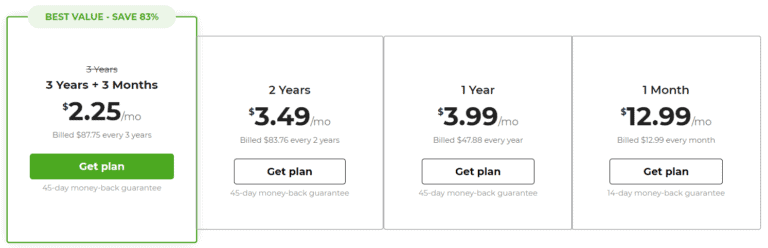
Thanks to its 9000+ servers in 100 countries, you get a healthier server spread than PureVPN to unblock content in more regions.
That could help justify why it’s costlier than PureVPN.
CyberGhost’s PC apps also have servers optimized for gaming and torrenting. This is like PureVPN’s P2P server section for torrenting, but PureVPN lacks gaming-specific servers across all its apps.
But CyberGhost doesn’t offer port forwarding like PureVPN, making it less desirable for torrent seeding.
That’s not a dealbreaker for most, anyway.
CyberGhost also offers automatic Wi-Fi protection on its mobile and PC apps. I routinely configure this easy-to-setup feature to protect my internet activity from hackers and network admins when connected to public/free/untrusted Wi-Fi networks.
Sadly, such automatic network protection is missing on PureVPN and PrivateVPN.
Furthermore, CyberGhost uses industry-standard AES 256-bit encryption across all servers and protocols to ensure the highest data integrity.
My Wireshark tests, while connected to a random CyberGhost server, only showed gibberish. So, I’m confident your internet activities remain private over this affordable VPN.
Speaking of privacy, this Romania-based provider has also been audited for its no-logs policy.
Finally, CyberGhost’s seven simultaneous connections are the lowest on this list. Still, it’s pretty close to PrivateVPN and PureVPN.

Enjoy these mouth-watering prices with CyberGhost’s one-time discounts.
Pros
- 9000+ VPN servers to unblock content and get local IPs in 100 countries
- Offers AES 256-bit encryption to keep the government, ISPs, network admins, and others out of your internet traffic
- Automatic Wi-Fi protection across PC and mobile devices
- Audited no-logs provider based in privacy-friendly Romania
- Beginner-friendly affordable VPN with gaming, torrenting, and streaming-optimized servers
Cons
- Not as cheap as PureVPN and PrivateVPN
- Offers the least simultaneous connections (seven)
PrivateVPN - Dedicated IP Addresses & Reliable Online Privacy From $2.00

PrivateVPN is slightly cheaper than CyberGhost, but CyberGhost ranks above it because it gives you more for the money.
What do I mean?
You only get 200+ servers in 63 countries with PrivateVPN, a far cry from what CyberGhost offers. It also lacks specialty streaming, torrenting, and gaming servers.
However, PrivateVPN is the best bet if you want dedicated IP addresses without an add-on: its plan includes dynamic dedicated IPs on selected locations, plus shared static IPs on all of them.
Whereas they’ll cost you an extra $2.50/month on CyberGhost’s 2-year plan.
On top of that, PrivateVPN offers free port forwarding on most of its servers. In contrast, CyberGhost doesn’t offer port forwarding, while PureVPN charges extra for this feature.
Although it’s ultra-cheap with these free add-ons, PrivateVPN doesn’t compromise on security, using the industry-standard AES 256-bit encryption. The cheap VPN provider performed as well as CyberGhost and PureVPN, never leaking my IP address, DNS details, or internet activities.
PrivateVPN also provides more options for advanced users, allowing you to choose:
- Preferred OpenVPN connection ports.
- Preferred OpenVPN encryption standards.
- Preferred Stealth VPN connection ports for obfuscation.
I recommend that beginners leave the settings at their default.
Otherwise, you might break something.
My speed tests revealed that PrivateVPN is faster than CyberGhost, managing 43Mbps against CyberGhost’s 39Mbps. Thus, it naturally performed better for torrenting and content streaming services.
It even supports the SOCKS5 proxy for faster torrenting!
Given its decent server spread, I had no issues unblocking BBC iPlayer, Hulu, and Amazon Prime Video over PrivateVPN.
On top of that, PrivateVPN’s ten simultaneous connections again put it ahead of CyberGhost.

Get all these value-added features at one low price with these PrivateVPN offers.
Pros
- Dynamic dedicated IPs on selected locations
- Free port forwarding on some servers
- AES 256-bit encryption for data protection on all servers and protocols
- 200+ servers to unblock content and get IP addresses in 63 countries
- Flexible security and privacy settings for more advanced users
- Faster than CyberGhost for streaming and torrenting
Cons
- Not as many servers as the other VPNs
- Might be too advanced for non-tech-savvy users
NordVPN - Premium Network & Threat Protection at a Budget 2-Year Price
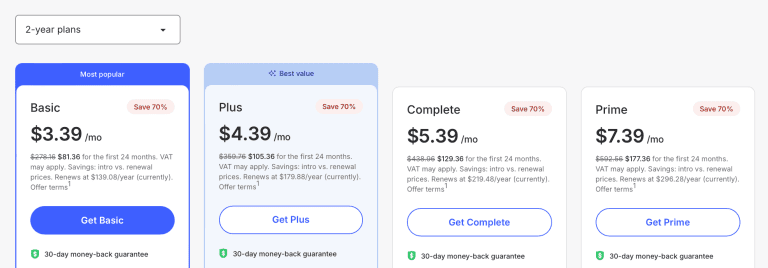
NordVPN is the priciest name on this list, which is exactly why it sits fifth. It earns the slot because its 2-year plan pulls a premium service down into budget territory: when I checked in September 2026, NordVPN listed the 2-year Basic plan at $3.49 a month ($94.23 for 27 months), with three extra months thrown in and a steep jump at renewal ($139.08 a year), exactly a dollar a month above Surfshark’s equivalent plan on the same day. NordVPN prices by region, so the exact figure at checkout may differ slightly.
For that money, you get the biggest footprint here by country: 7,000+ servers in 150 countries, 50 countries more than Surfshark and more than double PrivateVPN’s 63. Only CyberGhost runs more servers. I had no trouble landing local IP addresses in places the cheaper four skip entirely, and the usual suspects (Netflix, Hulu, and BBC iPlayer) unblocked on the first server I tried.
Speed is where the budget picks answer back. On my 100Mbps connection, NordVPN averaged 33Mbps over its NordLynx protocol, the slowest result of the five and a long way from PureVPN’s 87Mbps. It never stalled a 4K stream or a torrent, but if raw throughput is what you’re paying for, PureVPN and PrivateVPN are the quicker buys.
Where NordVPN pulls ahead is the security stack. Threat Protection blocks malicious sites on every plan, and the Pro version, on the plans above Basic, adds an ad and tracker blocker plus download scanning that keeps working with the VPN disconnected, which is the closest thing on this list to Surfshark’s CleanWeb. Then come Double VPN servers, obfuscated servers that hide the fact you’re using a VPN at all (something CyberGhost lacks), a kill switch, and a no-logs policy audited more than once from a Panama base outside every surveillance alliance.
It covers the whole house, too. NordVPN runs on routers, offers SmartDNS for smart TVs and consoles that can’t install a VPN app, and now allows P2P on every standard server (its separate P2P servers category is gone), so torrenting is a one-click affair. You get ten simultaneous connections, level with PureVPN and PrivateVPN and three more than CyberGhost, though not Surfshark’s unlimited allowance.
Line it up against Surfshark and the household math still favors Surfshark: unlimited devices for a dollar less. NordVPN is the pick for one person who wants the widest network and the deepest feature set on this list and doesn’t mind paying a little more for it.

Lock in the 2-year rate with these NordVPN discounts, and test it against the others under its 30-day money-back guarantee.
Pros
- 7,000+ servers in 150 countries, the widest spread on this list
- Threat Protection on every plan, with Pro adding ad, tracker, and malware blocking
- Double VPN, obfuscated servers, and a kill switch backed by an audited no-logs policy in Panama
- Router and SmartDNS support for smart TVs and consoles
- P2P on all standard servers for one-click torrenting
- Ten simultaneous connections and a 30-day money-back guarantee
Cons
- Highest price on this list, even on the 2-year plan
- Slowest in my tests at 33Mbps on a 100Mbps connection
- Ten devices against Surfshark’s unlimited
How to Set Up Your Best Cheap VPN Providers?
Follow the steps below to set up your cheap VPN for the best security and privacy anytime:
- Subscribe to your preferred cheap VPN. I recommend Surfshark (get discounts here).
- Download the VPN app to your preferred device. I’ll use Surfshark’s Windows PC app for this demonstration.
- Launch the app and log in with your account credentials (obtained in step #1 above).
- Pick a connection protocol in the app’s Settings. I recommend WireGuard, with IKEv2 as a fallback.
- Enable the Kill Switch in the same settings area to prevent accidental IP/DNS leaks.

- While you’re there, switch on CleanWeb to block ads, trackers, and malware.

- Head back to the Locations tab and search for a preferred server. I’ll use a United States server for this demonstration.

- Click the server and wait for the successful connection confirmation.
- Start unblocking content or browsing the web securely.

Frequently Asked Questions (FAQs)
Why Use a Free VPN Instead of a Cheap VPN?
It’s best to use cheap VPNs instead of free VPNs. Free VPN services are notorious for leaking/selling your data, using poor encryption, and slowing your connection speeds. In contrast, cheap VPNs give you the benefits of a premium VPN, like reliable content unblocking, security, and privacy at one low price.
Are There Any Dangers to Using Cheap VPNs?
There are no dangers to using cheap VPNs based on price alone.
However, some cheap VPN providers use underhand tactics like collecting and selling your data (or using your computer as a VPN server) to make up extra revenue on top of their low prices.
Thus, choose one of the best cheap VPN services like Surfshark to get the most for your money without sacrificing privacy or security.
Cheap Isn’t Always Bad
Cheap items and services are usually considered poor quality, and that’s true for some VPN service providers. However, the listed cheap Virtual Private Networks (VPNs) have been vetted for reliability, privacy, security, and top-shelf encryption.
The top option, Surfshark, even brings unique privacy and security features like CleanWeb and Multi-hop on top of unlimited simultaneous connections.
So, you can grab these Surfshark discounts to enjoy its low prices and get a 30-day money-back guarantee to test it risk-free.